|
BASIC TRAFFIC HANDLING SUMMARY
VOICE
W3YVQ, July 20, 2006, V6.7 |
In this document:
EMAIL ADDRESSES AND URLS, FORMATTING
TEXT, GROUP DEFINITION, GROUP COUNTING
ARL, THE ARRL NUMBERED RADIOGRAM PROWORD
BLANKS IN ARRL NUMBERED RADIOGRAMS
PREAMBLE VOICING, SPECIAL RULES
SINGLE MESSAGE VOICING EXAMPLE
BLANKS, USED IN BOOK TRANSMISSION
TRANSMIT ONLY WITH NCS PERMISSION
MESSAGE EXCHANGE, TWO STATIONS ON AND OFF NET
BULLETIN(S) TO MULTIPLE STATIONS, ON AND OFF NET
BOOK TO MULTIPLE STATIONS, ON AND OFF NET
INTRODUCTION
|
This document contains selected excerpts from the ARRL NTS Methods and Practices Guidelines (MPG, PSCM Appendix B). This summary of basic topics is intended to be a ready reference for the essentials of voice traffic handling taught in the local ARES® and NTS operating environments. It is a useful handout or web review to use as a follow-up to class work or practice nets. Mentors are encouraged to use the higher level documentation to build lesson plans for more intensive training in the various methods of efficient traffic net operations and net control duties as well as the integration of the digital modes. Also included here are the Precedences, ARRL Handling Instructions and ARRL Numbered Radiograms often provided to the new amateur radio operator. |
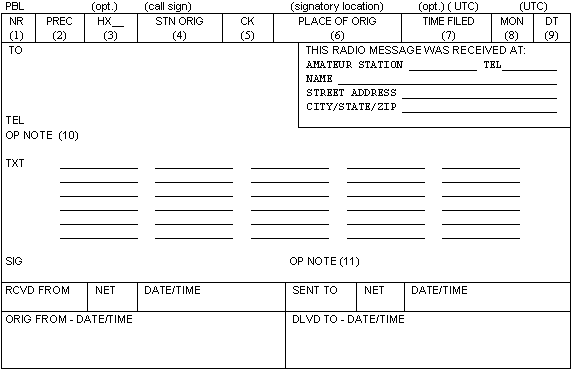
1. THE ARRL MESSAGE FORMAT
(Prepared for this document. Figures in parentheses are
referred to in sections below.):
|
|

MESSAGE CHARACTERS
|
· Letters (caps), Figures and/or Slashes (“/”, slash, slant bar, or diagonal) are permitted when formatting the ARRL Radiogram. |
|
|
“X” |
Substituted for a period in the text (except to end the last sentence - the text may not end with an “X”). |
|
“R” |
Substituted for a decimal point in figure groups when the message is formatted, as in 146R67 for 146.67. |
|
· Other punctuation is spelled out. |
|
|
“DASH” |
The hyphen is not permitted, hence the group “DASH” is used to separate the parts of a 9 digit zip code for example. Hyphen and dash, and all other punctuation, is spelled out in the text where needed. |
|
(Formatting rules for Preamble parts follow. See also Preamble Voicing, Special Rules.) |
|
|
(#) |
PREAMBLE PART |
|
1 |
Message Numbers may contain only figures with no leading zeros. Number may be preceded by SVC + space for service messages. See Service Messages. |
|
2 |
Precedence: Emergency, P, W, or R. May be preceded by “TEST” for exercise messages. See Precedence table, Exercise Messages and Preamble Voicing special rules. |
|
3 |
Handling Instructions: OPTIONAL. See table of Handling Instructions including the formatting rules at the bottom of the table. |
|
4 |
Station of Origin: Call sign of the station originating the message - unchanged from origination through delivery. |
|
5 |
Check: Number of groups in the text, preceded by ARL + space if ARRL Numbered Radiograms present in the text. No part of the radiogram may be altered except in the case of an error leading to a discrepancy between the check and the actual group count the check may be appended with the corrected value, as in: 12/13, 12/ARL 12. |
|
6 |
Place of Origin: The location of the person for whom the message is originated, not necessarily the location of the station of origin. When different a “signature op note” may be used as needed to instruct handlers relative to servicing or replies. |
|
7 |
Time Filed: OPTIONAL (Time message inserted into the amateur system -seldom used on Routine traffic, often used on Priority traffic to “time stamp” the content.) Unmarked times are assumed to be UTC and must agree with the month and date. If local time is to be used (often done for served agencies) a time zone designator must be added, as in: 1430L, or 1430EST, or 1430EDT, etc., and the month and date must agree. (The time filed is formatted as a single mixed group with no spaces.) |
|
8, 9 |
Month, Date: The default month and date are UTC. If a local Time Filed is used the month and date must agree with the Time Filed. The Month group is entered as the three letter abbreviation. The Date group is entered as one or two figures with no leading zeros. |
OP NOTES
|
10 |
Address Op Note: Used to include information relative to delivery, etc. Content is generally not delivered to the addressee. |
|
11 |
Signature Op Note: Used to include information relative to replies or servicing, etc. Content is generally not delivered to the addressee. |
SERVICE MESSAGES
|
A service message is sent between stations relative to message handling or delivery. The letters SVC (voiced as “SERVICE”) are placed ahead of the message number. The precedence should be the same as that of the message being serviced. Since they affect timely delivery service messages are generally handled before routine messages. SVC is not a message precedence. Example voicing for a preamble beginning SVC 16 R W1AW…: “number SERVICE ONE SIX ROUTINE WHISKEY ONE ALFA WHISKEY…” |
PRECEDENCES
|
(See ARRL FSD-3) |
|
EMERGENCY (Spelled out on form.*) |
|
PRIORITY
(P) |
|
WELFARE
(W) |
|
ROUTINE
(R) |
|
Notes: These precedences are not meant to prohibit handling lower level traffic until all higher levels are passed. Common sense dictates handling higher precedence traffic before lower when possible and/or outlets are available. |
|
* EMERGENCY:
Emergency is always spelled out in the preamble. Means other than Amateur
Radio should be included in the delivery options. EMERGENCY messages have
immediate urgency. They should take priority over any other activity and
should be passed by the best means available with the cooperation of all
stations. |
EXERCISE MESSAGES
|
Messages in the ARRL format passed for test and exercise purposes may be given a precedence preceded by the word “TEST”, as in “TEST R”, “TEST P”, “TEST W”, or “TEST EMERGENCY”. It is customary to indicate within the text of such messages the words “TEST MESSAGE” as the first two groups, or “EXERCISE” as the first and last groups of the text. This helps alert listeners to the nature of the content to avoid undue alarm. In some exercises, the life of the message may be terminated when the exercise period is terminated, i.e., any such messages are not handled after the exercise. Consult with the ARES/RACES/NTS group conducting the test to determine if such messages should be filed, handled and delivered afterwards to permit a full evaluation of the exercise. |
HANDLING INSTRUCTIONS
|
ARRL RADIOGRAM HANDLING INSTRUCTIONS ("HX-CODES") |
|
|
HXA__ |
(Followed by number.) Collect landline delivery authorized by addressee within ____ miles, (if no number in blank, authorization is unlimited). This means that the originating station has obtained authorization from the addressee, through the party originating the message, to call collect when delivering the message. |
|
HXB__ |
(Followed by number.) Cancel message if not delivered within ____ hours of filing time; service message back to originating station. NOTE: filing time must be included in preamble. |
|
HXC |
Report date and time of delivery of the message back to the originating station by service message. |
|
HXD |
Report to originating station the identity of station from which received, plus date and time. Report identity of station to which relayed, plus date and time, or if delivered, report date and time and method of delivery (this information is sent by service message to the originating station). |
|
HXE |
Delivering station get reply from addressee, originate message back. This reply is sent to the person from whom the original message was received, at the "place of origin", using a full address obtained from the addressee. If an address is not available, a reply can often be successfully routed back to the station of origin since a record is kept of originator's info. |
|
HXF__ |
(Followed by a number.) Hold delivery until ____ (date). This blank contains the number of the day on which the message should be delivered (even if it is in the following month). |
|
HXG |
Delivery by mail or landline toll call not required. If toll call or other expense involved, cancel message and send service message back to originating station. |
|
Compliance
with these instructions is mandatory. (See ARRL FSD-218, the "Pink
Card") |
|
EMAIL ADDRESSES AND URLS, FORMATTING
|
When so formatted these addresses may be voiced with the standard protocols. All characters are assumed to be contiguous unless noted otherwise. Groups are counted after formatting. |
||||||
|
EMAIL: |
john_doe@domain.net - JOHN UNDERSCORE DOE ATSIGN DOMAIN DOT NET |
|||||
|
URL: |
http://www.arrl.org/ - HTTP COLON SLASH SLASH WWW DOT ARRL DOT ORG SLASH |
|||||
|
Also encountered may be: |
||||||
|
(~) |
TILDE |
(%) |
PERCENTSIGN |
(<) |
LESSTHANSIGN |
|
|
(#) |
NUMBERSIGN |
(&) |
AMPERSAND |
(>) |
GREATERTHANSIGN |
|
|
(\) |
BACKSLASH |
(*) |
ASTERISK |
|
UPPERCASE [letter(s)] |
|
|
(-) |
DASH |
($) |
DOLLARSIGN |
|
LOWERCASE [letter(s)] |
|
|
The group SPACE may be used if a space is an integral part of the syntax sequence. Note that a combination such as “#somd” (1 group) becomes NUMBERSIGN SOMD (two groups), voiced “NUMBERSIGN… initials SIERRA OSCAR MIKE DELTA.” All sequences so rewritten as groups should return the original email address, packet address, or URL at the point of delivery. |
||||||
TEXT, GROUP DEFINITION, GROUP COUNTING
|
The radiogram text is generally 25 words or less using the characters shown above. The occasional text with a few more groups is permissible to avoid splitting the message. Much longer messages may be broken into two or more radiograms (which may be transmitted booked) at a point where each separate part makes sense as a single message to the greatest extent possible.
Examples: |
||
|
1 GROUP |
2 GROUPS |
3 GROUPS |
|
THANKYOU |
THANK YOU |
I THANK YOU |
|
X |
555 1234 |
410 555 1234 |
|
JPOLE |
J POLE |
2M J POLE |
|
146R67 |
146R67 MHZ |
146 DECIMAL 67 |
|
11PM |
11 PM |
11 PM LOCAL |
|
2345EST |
2345 EST |
1145 PM EST |
|
BACOOEPEOC |
BACOOEP EOC |
BACO OEP EOC |
ARL, THE ARRL NUMBERED RADIOGRAM PROWORD
|
ARL (in check) |
Indicates the presence of one or more ARRL numbered radiogram(s) in the text. The letters ARL precede the Check figures separated by a single space, as in: ARL 12. |
|
ARL (in text) |
The separate initial group ARL precedes each ARRL Numbered Radiogram (numbers spelled out) in the text, as in: ARL FIFTY ARL FIFTY SIX NEW LICENSE |
BLANKS IN ARRL NUMBERED RADIOGRAMS
|
BLANKS ARL Numbered Radiograms |
Some ARRL Numbered Radiograms contain one or more blanks for information to be added by the originator. When formatting the single radiogram the information for the blank(s) follows the ARRL Radiogram number(s), as in ARL FIFTY THREE LETTER …, or ARL FORTY SEVEN 305 W1AW MAR 15 2330 … |
2. VOICING THE MESSAGE:
|
Voicing protocols are intended to help avoid errors inherent in speech perception, to help ensure the receiving operator knows what the sending operator is doing at all times and to help ensure the highest possible degree of accuracy and efficiency in radio message transfer. Except for the prowords, introducers and operational words presented herein the receiving operator copies everything else voiced by the sending operator between the framing prowords. Extraneous words, comments and explanations, etc., are counterproductive and are considered poor practice.
The resultant copy should always be a replica of
the original radiogram in every respect. “Every single word not absolutely needed may be dispensed with profitably.” - Operating An Amateur Radio Station (OARS pamphlet), CD-4(1/83), ARRL, Inc., Newington, CT, page17. |
ITU PHONETIC ALPHABET
|
A |
ALFA |
J |
JULIETT |
S |
SIERRA |
2 |
TWO |
|
B |
BRAVO |
K |
KILO |
T |
TANGO |
3 |
THREE (TREE) |
|
C |
CHARLIE |
L |
LIMA |
U |
UNIFORM |
4 |
FOUR |
|
D |
DELTA |
M |
MIKE |
V |
VICTOR |
5 |
FIVE (FIFE) |
|
E |
ECHO |
N |
NOVEMBER |
W |
WHISKEY |
6 |
SIX |
|
F |
FOXTROT |
O |
OSCAR |
X |
X-RAY |
7 |
SEVEN |
|
G |
GOLF |
P |
PAPA (PA-'PA) |
Y |
YANKEE |
8 |
EIGHT |
|
H |
HOTEL |
Q |
QUEBEC (KAY-'BEK) |
Z |
ZULU |
9 |
NINE (NINER) |
|
I |
INDIA |
R |
ROMEO |
1 |
ONE |
0 |
ZERO |
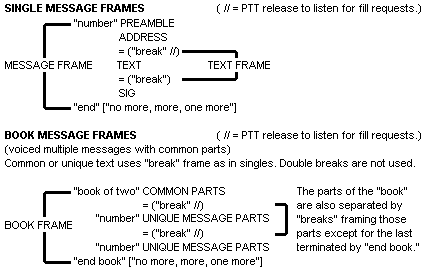
FRAMES
|
A receiving operator needs to know where copy should begin and end. This is indicated by the sending operator using certain prowords to “frame” the individual message, the text, a message book, or individual parts of booked messages.
|
|
|
|
(See Single Message Voicing Example and Book Voicing Example.)
|
INTRODUCERS
|
Words used to introduce non-plain-text groups in the address, text and signature. Each group eligible for introduction or spelling is dealt with one group at a time. When voicing an introduced group (or preamble group eligible for introduction) the characters are each voiced one character at a time, letters phonetically. There is only one introducer used per group. (An additional introducer would indicate the beginning of a new group.) See also the special rules for Preamble Voicing.
|
||
|
Introducer |
Example |
Voicing: One introducer per group. Voice one character at a time, letters phonetically. Introducers are shown here in lower case except for the letters “ARL.” |
|
AMATEUR CALL |
W1AW |
“amateur call WHISKEY ONE ALFA WHISKEY” (No appended information - see MIXED GROUP for voicing call signs with appended information.)
|
|
AMATEUR
CALLS |
(special) |
Used to introduce a series of amateur call sign groups in a message text, using the introducer only once for the first of the series, as in net reports, etc. Use with care. In such a series all the groups must be of the same type.
|
|
ARL
(in check) |
ARL 15 |
“A R L… ONE FIFE.” The “ARL” is voiced as three separate letters without introduction, and the check figures follow after a space pause without introduction, voiced one digit at a time.
|
|
ARL
(in text) |
ARL SIXTY |
“A R L… SIXTY I spell SIERRA INDIA X-RAY TANGO YANKEE.” The “ARL” is voiced as three separate letters, although in difficult conditions it may be introduced as an initial group as in “initials ALFA ROMEO LIMA.”
|
|
FIGURE,
|
6 |
“figure SIX” “figures ONE SIX” (Compound form sixteen, etc., not used.)
|
|
Telephone figures in text. |
555 1234 |
“figures FIFE FIFE FIFE… figures ONE TWO TREE FOUR” (Two groups. Three groups, as in 410 555 1234, are handled in a similar fashion.)
|
|
Telephone figures following a zip code in an address or signature address - the typical message address. |
(special) |
Address telephone figure groups after a zip code are introduced with the figures introducer only once, as in 410 555 1234: “figures FOUR ONE ZERO… FIFE FIFE FIFE… ONE TWO TREE FOUR”, using separating pauses. (Such groups in the text are introduced individually.)
|
|
Telephone
figures following an address or signature address with NO preceding zip
code: |
(special) |
Address telephone figure groups with NO preceding zip code are introduced with the “PHONE FIGURES” introducer used only once (this is a signal for the copying operator to skip the zip code in the copy). Given: BALTIMORE MD 410 555 1234, voice: “BALTIMORE MARYLAND phone figures FOUR ONE ZERO… FIFE FIFE FIFE… ONE TWO TREE FOUR.” (Elsewhere each group is introduced.)
|
|
Nine
digit ZIP codes. |
(special) |
Format - 21200 DASH 2345, voiced with the “figures” introducer used only once as in “figures TWO ONE TWO ZERO ZERO DASH I spell D A S H… TWO TREE FOUR FIFE” (Elsewhere each group is introduced.)
|
|
Canadian
or other mixed group ZIP codes. |
(special) |
Format - A4X 2L7, voiced as in "mixed groups ALFA FOUR X-RAY... TWO LIMA SEVEN", using a pause between groups. (Elsewhere each group is introduced.)
|
|
INITIAL |
X |
“initial X-Ray” (The older non-introducing method will result in copy of the word “X-Ray”, not “X”.) |
|
|
A |
“initial ALFA” |
|
INITIALS |
CW |
“initials CHARLIE WHISKEY”
|
|
INITIAL
GROUPS |
(special) |
Used
to introduce a series of initial groups in a message text, using the
introducer only once for the first of the series as in net reports, etc., for
voicing a series of suffixes. Use with care. In such a series all the groups
must be of the same type. |
|
MIXED
GROUP |
B2 |
“mixed group BRAVO TWO” “mixed group ALFA MIKE SLASH TREE” (Note there is no additional introducer for the figure 3.) |
|
|
W1AW/3 |
“mixed group WHISKEY ONE ALFA WHISKEY SLASH TREE” (This is not a simple call sign but a mixed group.)
|
|
MIXED
GROUPS |
(special) |
Used to introduce a series of mixed groups in a message text, using the introducer only once for the first of the series as in net reports, etc., for voicing a series of call signs appended with added information. Use with care. In such a series all the groups must be of the same type.
|
|
MIXED
GROUP FIGURE |
2M |
“mixed group figure TWO MIKE” “mixed group figure TWO SLASH ALFA” “mixed group figure TREE PAPA MIKE” “mixed group figure FOUR SLASH BRAVO TREE” (Note there is no additional introducer for the figure 3.) |
|
MIXED
GROUP FIGURES |
1430PM |
“mixed group figures ONE FOUR TREE ZERO PAPA MIKE” (single group) “mixed group figures ONE FOUR SIX ROMEO SIX SEVEN” (single group)
|
|
OP NOTE |
OP NOTE |
Voiced as prowords to introduce address or signature op note information. The information within an op note is voiced as in text groups. The OP NOTE introduction follows the last of the address or signature information. |
INTRODUCER SUMMARY
|
INTRODUCER* |
GROUP |
VOICING |
|
AMATEUR CALL |
W1AW |
“amateur call WHISKEY ONE ALFA WHISKEY” |
|
ARL In check |
ARL 12 |
“A R L ONE TWO.” |
|
ARL In text |
ARL |
“A R L SIXTY I spell SIERRA INDIA X-RAY TANGO YANKEE” |
|
FIGURE |
4 |
“figure FOUR,” |
|
FIGURES |
16 |
“figures ONE SIX.” |
|
INITIAL |
A |
“initial ALFA,” |
|
INITIALS |
PM |
“initials PAPA MIKE.” |
|
MIXED GROUP |
B2 |
“mixed group BRAVO TWO,” “mixed group BRAVO SLASH SIX,” “mixed group WHISKEY ONE ALFA WHISKEY SLASH ONE” |
|
MIXED
GROUP |
2PM |
“mixed group figure TWO PAPA MIKE,” “mixed group figure TWO SLASH TREE,” |
|
MIXED
GROUP |
2310Z |
“mixed group figures TWO TREE ONE ZERO ZULU,” “mixed group figures ONE FOUR SIX ROMEO SIX SEVEN.” |
|
Introducers alert the receiving operator to the special nature of the following group to be transmitted. Introducers may be voiced in a slightly different tone of voice and a little faster than copy speed to help distinguish them. This process becomes second nature to experienced traffic handlers. Remember that all introduced groups, or groups eligible to be introduced in the Preamble, are voiced one character at a time, letters phonetically. * See the Introducers section regarding the introduction of telephone numbers and zip codes in addresses, OP NOTE, and the special use of AMATEUR CALLS and INITIAL GROUPS for introducing a series of like groups. |
||
PREAMBLE VOICING, SPECIAL RULES
OPERATIONAL WORDS
|
(Used to tell the receiving operator what you are doing.) |
|
|
I SPELL |
Say the single group, immediately add “I spell”, then spell the group with letters or phonetically, as in: “TWO I spell T W O”, or “BACH I spell BRAVO ALFA CHARLIE HOTEL.” |
|
I SAY AGAIN (emphasis) |
Say a group, or a phrase of several groups, say “I say again”, and repeat the group(s) for emphasis, as in: “BRACKETS I say again BRACKETS;” or “BACK TODAY I say again BACK TODAY.” |
|
I SAY AGAIN (on error) |
Given the text: “BACK NEXT TUESDAY;” correct sending error: “BACK TUESDAY I say again BACK NEXT TUESDAY.” Note after “I say again” you go back to the last group sent correctly and resume transmission including that group. This action distinguishes this use of “I say again.” |
|
break |
Proword to frame voicing the text or separate parts of a book. |
|
number - end |
Prowords to frame voicing the single radiogram. |
|
book of (qty.) - end book |
Prowords to frame voicing a book of messages. |
|
more, one more, no more |
Operational words following end or end book to indicate the number of messages to follow. “No more” implies “over.” |
|
OVER |
Go Ahead (end of transmission). Using “OVER” to end voice transmissions greatly helps in avoiding “doubling” with another station. |
|
(Used to tell the receiving operator what you mean.) |
|
|
ROGER |
“All received and understood.” (Does NOT mean yes!) |
|
CHARLIE, AFFIRMATIVE |
Means “YES.” |
|
NO, NEGATIVE |
Means “NO.” |
SPELLING
|
· GROUPS ARE SPELLED ONE AT A TIME. Voice the group then immediately say “I spell,” then spell the group with either letters or phonetics. Do not voice two or more groups and then go back to spell them. “I spell” is used for one group at a time. If a group requiring spelling is passed over the sending operator may use “I say again” to go back to the group in question, spell it, and then continue on with transmission from that point. (Alternatively the introducer “initials” may be used to spell some groups as in Jon, “initials JULIETT OSCAR NOVEMBER,” without first voicing the “Jon.”) · ADDRESSEE LAST NAMES are customarily spelled with phonetics. Last names are critically important for verification and delivery of radiograms. · OTHER PROPER NAMES are customarily spelled with letters or phonetics. This is not mandatory for names such as commonly understood location names or names such as “John,” but “Jon” would be spelled. Upon hearing the “I spell” the receiving operator will wait to hear the group spelled. Any proper name for which the spelling is not commonly understood should be spelled out · SOUND-ALIKE OR UNUSUAL GROUPS are spelled with letters or phonetics, as in: “TWO I spell T W O,” or “OXEN I spell OSCAR X-RAY ECHO NOVEMBER” · The choice to use LETTERS rather than PHONETICS depends upon whether the letters may sound alike or be uncertain to the receiving operator (the B, C, D, E, G, P, T, V, Z effect). Overuse of phonetics wastes time in good radio conditions, but when there is any doubt about the likelihood of accurate copy spell it out with letters, or, in poor conditions, use the phonetics which greatly aid in correct copy. · ARRL NUMBERED RADIOGRAM numbers (always written out as words) are always voiced, then, using “I spell,” each individual number is spelled with phonetics. “Fifty and Sixty, and the teen’s compounds, tend to sound alike over radio. Where two numbers are used each is spelled individually, as in: “A R L SIXTY I spell SIERRA INDIA X-RAY TANGO YANKEE… ONE I spell OSCAR NOVEMBER ECHO” |
SENDING SPEED
|
· Perhaps the single most difficult skill in sending record traffic is learning the speed at which to voice the groups transmitted. The receiving operator may be copying with pen and paper, using a favorite old “mill,” or using word processing. Knowing which method is in use is helpful in tailoring sending speed but assuming pen and paper is the starting point. · Introduced and spelled groups are sent one character at a time thus it is generally easy to “keep up” with the sending speed for those. Other groups or phrases transmitted must be sent with sufficient clarity and appropriate speed for the receiving operator to perceive what to copy and not to have to rush to “keep up.” Rushing leads to errors and/or illegible copy. · An experienced operator will, for example, transmit a phrase or long group followed by an “X” by sending the phrase or group, pausing for copy time, and then voicing the “X-RAY.” Otherwise the “X” may be forgotten by the receiving operator concentrating on spelling out the prior phrase or group. · Remember that spaces are also a critically important part of the process. Spaces, or pauses in articulation, convey group separation and other signals to the receiving operator. Sending “Glen Dale Court” too quickly may result in the incorrect copy of Glendale Court. Omission of a pause is also a signal, for example, when sending a group, voicing “I spell” immediately, and then going back to voice the characters one at a time (the receiving operator hearing “I spell” immediately will wait for the spelling). · Introduction and spelling also clearly indicate that only one group is being treated in the transmission. · The sending operator should always voice the groups as recommended and visualize the ongoing copy process. When transmitting pretend to “spell out” and copy the groups as they are sent. This will automatically allow the extra time needed by the receiving operator to spell out the longer groups or phrases. · This all requires practice. Sending traffic on regular nets or across a table from a receiving operator can help you to learn how to do this effectively. Receiving traffic yourself will give you insight into the effects of sending speed, but you will still have to concentrate on paying special attention to this matter during transmission. Knowing how to do this well is a mark of an experienced traffic handler. During emergencies an inexperienced operator may send too quickly and not be experienced in these protocols resulting in numerous fill requests, uncertainty and reduction in net throughput to half or worse.
· The objective in handling written radio message traffic is to transmit, copy, relay and deliver the message EXACTLY as it was written by the originator.
|
MESSAGE VOICING RULE SUMMARY
|
FRAME START |
· A single message frame begins with “number,” the book frame begins with “book of [number].” Frame prowords are not copied. |
|
PREAMBLE |
· All groups are voiced using the rigorous rules for text groups except that for all groups eligible to be introduced the introducer is omitted and the characters are sent one at a time, letters phonetically. See Preamble Voicing. |
|
ADDRESS |
· All groups are voiced using the rigorous rules for text groups except special rules apply for introducing and voicing telephone figures and certain zip codes. Three groups of telephone figures are introduced with “figures” once at the beginning. If no zip code is present telephone figures are introduced with “phone figures.” Last names are spelled with phonetics. See Introducers, Figures. |
|
OP NOTE |
· Address Op Note regarding delivery is introduced with the prowords “op note” and the information within the Op Note is voiced using text rules. |
|
TEXT |
· The text is begun with the proword “break” followed by a listening pause. · The most rigorous voicing rules apply. All eligible groups are introduced as described in the Introducers rules which require each character in the group to be voiced individually, letters phonetically. · A series of the same kind of groups eligible to be introduced may be introduced once in the plural at the beginning of the series (a shortcut of convenience for net reports, etc.) · Proper names are spelled with letters or phonetics after using “I spell.” Sound-alike groups, plurals and unusual words are spelled with letters or phonetics after using “I spell.” · A series of groups may be voiced as a phrase so long as there are no groups contained therein eligible to be introduced. · The text ends with the proword “break” without a following listening pause. · The beginning and ending text frame “break” groups are not copied or counted in the check. |
|
SIGNATURE |
· All groups are voiced using the rigorous rules for text groups except special rules apply for introducing and voicing telephone figures and certain zip codes. Three groups of telephone figures are introduced with “figures” once at the beginning. If no zip code is present telephone figures are introduced with “phone figures.” Last names are spelled with phonetics. See Introducers, Figures. |
|
OP NOTE |
· Signature Op Note regarding servicing or replies is introduced with the prowords “op note” and the information within the Op Note is voiced using text rules. |
|
FRAME END |
· Single message copy stops at the proword “end.” Book copy stops at the prowords “end book.” These frame prowords are not copied. The end of the frame is concluded with the operational words “more, one more, no more” as appropriate. “No more” implies “over.” See the following message and book voicing examples and the Message Exchange. |
|
SPEED |
· Send the message using appropriate speed for manual pen and paper copy unless requested to do otherwise. Transmit pauses clearly - they are free. |
|
EXTRANEOUS WORDS |
· All other extraneous words or comments are dispensed with. Except for introducers and operational words everything else voiced is copied by the receiving operator. Avoid voicing all such extraneous words or message part names when transmitting. |
SINGLE MESSAGE VOICING EXAMPLE
|
· Use the appropriate frame prowords (number, end, etc.) · Bold groups should be spelled. · Underlined groups in the Preamble are eligible for introduction but the introducers are omitted. (See also the Preamble Voicing). · Underlined eligible groups elsewhere are introduced. |
|
|
3 TEST P W1AW 26 MIDDLE RIVER MD 1118L MAR 19 |
Preamble - no introducers used. |
|
JOHN
P SMYTHE EC W3XYZ |
Addressee (last name spelled with phonetics), title, call and address. |
|
410 555 1234 |
See special tel. nr. introduction. |
|
= |
Break: “BT,” or “=,” or blank line. |
|
EXERCISE
X WAVE HIT AT |
Text (this message is shown as a test priority exercise message). |
|
= |
Break: “BT,” or “=,” or blank line. |
|
PHIL W1AW |
Signature |
|
|
Blank line before next message. |
|
(Voicing
example - … indicates a copy pause ) PODUNK
I spell PAPA OSCAR DELTA UNIFORM NOVEMBER KILO MARYLAND… |
|
BOOK VOICING EXAMPLE
|
Messages having common parts may optionally be voiced “booked” to save transmission time. The resultant copy must be able to be restored to single message replicas of the originals. Booking is a voicing option of the operators. Given the example messages: |
|
|
5 R W1AW ARL 9 NEWINGTON CT MAY 16 JOHN
SMITH |
6 R W1AW ARL 9 NEWINGTON CT MAY 16 JAMES
DOE |
|
(Book
voicing example - … indicates a copy pause ) |
|
BLANKS, USED IN BOOK TRANSMISSION
|
Booking is a transmitting technique used to save time in transmission by avoiding repeating common parts in a number of messages. It is used by agreement between operators and is always optional. (Examples below are shown written out - use proper voicing when sending.)
|
|
BLANKS, ONE FOR ONE SUBSTITUTION: · When sending books with a common text except for one or more groups which may be variable, one or more “blank” groups may be used as place holders in the fixed text to indicate each of the groups to be provided in the variable message parts later. · With this method the “blanks” provide for a group count in the common text which agrees with the Preamble Check. This is a signal to the receiving operator that there will be a group for group correlation in the variable text for the contents of each “blank” sent later. This one for one substitution defines the variable text as having only one group representing each “blank” used in the common text, hence there is no ambiguity between the groups transmitted in the variable text. · These “blanks” may be associated with plain text, or with ARRL Numbered Radiograms, or both. · Example common text, check ARL 8: break ARL FIFTY THREE BLANK ARL FIFTY SIX BLANK break (SIG) break and in the variable parts: number 12 (address) break LETTER LICENSE break number 13 (address) break PACKAGE APPOINTMENT end book no more
· Multiple “blanks” are permitted, each in the position in the common text of the groups to be given later. Generally if more than two consecutive “blanks” are required a single placeholder method is used (see below).
|
|
BLANKS, SINGLE PLACEHOLDER FOR MULTIPLE GROUPS: · When sending books with a common text except for a number of groups which may be variable, and more than two consecutive “blanks” would be required as single group placeholders, it is permissible to use a single placeholder for all the variable groups even though the common text will not have a group count which agrees with the Preamble Check. The receiving operator will recognize the disparity and watch for the number of groups used in the variable texts. (When parts of a book are reformed into single messages the resultant group counts for the texts for each message must agree with the given Preamble Check.) · If more than one “blank” of this type is used in a common text care must be taken to ensure that there will be no ambiguity in the variable texts given later as to where the information from one “blank” ends and the next begins (adding an “X” or other marker between groups is not permitted to separate such groups). Thus if ambiguity would result by using more than one such single “blank” placeholder, each in place of multiple groups, it would be wise to avoid booking the message transmission (or the sending operator may use a single “blank” for a block of text as shown in the next part below). · Such single placeholder “blanks” may be associated with plain text, or with ARRL Numbered Radiograms, or both. · Example common text to different addressees, Check ARL 8: break ARL FORTY SEVEN BLANK break (SIG) break and in the variable parts: number 14 (address 1) break 305 W1AW MAR 15 2330 break number 15 (address 2) break 307 W1AW MAR 16 0745 end book no more · Example common text to the same addressee, Check ARL 8: (address) break ARL FORTY SEVEN BLANK break (SIG) break and in the variable parts: number 14 break 305 W1AW MAR 15 2330 break number 15 break 307 W1AW MAR 16 0745 end book no more
|
|
BLANKS, BLOCK OF TEXT TO REDUCE AMBIGUITY: · Where multiple single placeholder “blanks” are required to book separate parts of a common text where ambiguity would result in determining group boundaries in the variable parts a single “blank” may be used for a block of text. This allows the unchanging intermediate groups between the variable parts to form a boundary between the numerous groups. · Example common text to different addressees, Check ARL 18: SCHEDULED TO LEAVE TONIGHT X ARL SIXTY FIVE BLANK 73 break (SIG) break and in the variable parts: number 14 (address 1) break STL MAR 10 1330 UA 701 ARL EIGHT 6 break number 15 (address 2) break BWI MAR 10 1745 C 15 ARL EIGHT 10 end book no more
|
JUMPING AHEAD
|
· A receiving operator, recognizing a “standard message” from an originator, might interrupt the sending with “SIGNATURE” (at the “break” before the text) as soon as the address is received. The sending operator skips the text, sends “break,” and follows with the signature. · If the receiving station interrupts with a ROGER at the “break” before the text it is indicating it knows both the text and signature, however the sending operator should send the signature and signature op note, if an op note is present, when the op note is not “standard” for that message. If in doubt the sending operator should at least confirm the receiving station has the op note.
|
FILL REQUESTS
|
At the first text frame break or at the end of the message the receiving operator may ask for repeats of specific groups or part names, or may request confirmation of groups copied. This is done with a simple declarative statement such as “word after THE,” or “street address,” etc., or “confirm HAMFEST.” The interrogative is implied. The sending operator repeats the group(s) requested or confirms the copy given. Notice that “OVER” is not required in such exchanges. The receiving operator then may make an additional request or reply “ROGER,” or “GO AHEAD,” to resume the exchange. The requests follow: |
|
|
GROUPS |
“[IN (part)] WORD AFTER (group(s))" · The optional “[IN (part)]” refers to the PBL, addressee, street address, city, zip, telephone number, text, signature, op note, or whatever part of the message to which you wish to direct the attention of the operator for the fill request. The “[IN (part)]” is not used unless necessary for clarity in the request. |
|
PART NAME |
To request repeat of a part of the message ask “(part name)", such as preamble, number, precedence, handling instructions, station-of-origin, check, city-of-origin, date, last name addressee, street address, city, zip, telephone, address op note, text (entire), signature, signature op note, etc. Simply say “preamble”, “text”, “zip”, or “signature”, etc., and the sending station will repeat that part of the message specified. |
|
CONFIRM |
To verify a group or part ask: “CONFIRM
(group(s))";
|
|
The shortest and most efficient method is preferred and is
shown here. Given a
message text and signature as follows: |
||||
|
STN |
FILL REQUEST (1) |
STN |
RESPONSE (2) |
|
|
RX: |
“WORD AFTER HOME” |
TX: |
“NEXT” |
|
|
RX: |
“WORD BEFORE BE” |
TX: |
“WILL” |
|
|
RX: |
“BETWEEN ARRIVING AND WEEK” |
TX: |
“HOME NEXT” |
|
|
RX: |
“CONFIRM HOME” |
TX: |
“CONFIRM” |
|
|
RX: |
“CONFIRM THIS WEEK” |
TX: |
“NEXT WEEK” (3) |
|
|
RX: |
“IN TEXT ALL AFTER HOME”, (Use of [IN (PART)]) |
TX: |
“NEXT WEEK” |
|
|
RX: |
“SIGNATURE”, (Use of PART NAME) |
TX: |
“LLOYD I spell L L O Y D” |
|
|
1. |
The request may contain one or more groups as required for clarity. For example, if there is more than one “X” in the message text give the group before the “X” and the “X” to reduce the ambiguity. |
|||
|
2. |
Transmit requested group(s). There is no need to repeat the request. There is no need to transmit additional groups before and after the group(s) requested unless there is some need for particular emphasis or clarity by framing. Simply give the receiving operator what is asked for, remembering on repeaters to allow time for the links and transmitters to come up before voicing. Notice that “OVER” is not required in such exchanges. |
|||
|
3. |
“NEXT” might be spelled to emphasize the error correction. |
|||
3. DIRECTED TRAFFIC NETS
ID REQUIREMENTS
|
· Give your full call sign when checking into the net and when excused directly from the net. Give your full call sign after making comments, other contributions to the net and exchanging traffic. · Suffixes may be used to seek permission to transmit. Suffixes may be used to acknowledge leaving the net when dispatched to a stack. No response is expected from individual stations excused en-mass by list or by closing the net.
|
CHECKING IN, LISTING TRAFFIC
|
Listen to the NCS. Open net calls (for any stations) or specific net calls will be made from time to time. When the appropriate call is made for your category check into the net with the following information. List all your business at the first check-in opportunity. |
|||||
|
[CALL] |
[JOBS] |
[ASSIGNMENTS] |
[TRAFFIC STATUS] |
[TRAFFIC LIST] |
[COMMENT] |
|
(full call sign) |
Such as alternate net control, etc. |
Liaison assignments, using “FROM” and “TO” net name as required for clarity, |
1)
“NO TRAFFIC”; (OVER
is not required unless a comment is added), |
(none) |
(Info useful or needed by the NCS.) End with OVER. |
|
|
|
then voice traffic status 1, 2, or 3. |
2) “WITH TRAFFIC”, if multiple responders possible; or |
Wait for NCS request to “LIST” then “(call sign) TRAFFIC (TRAFFIC LIST)” … |
(Info useful or needed by the NCS.) End with OVER. |
|
|
|
|
3) If single responder; “TRAFFIC…” |
Give full “(TRAFFIC LIST)” … |
(Info useful or needed by the NCS.) End with OVER. |
|
Examples: “W1AW… [ALTERNATE NET CONTROL]… [FROM FIRST REGION]… TRAFFIC… [PODUNK ONE]… [PODUNK HOLLOW TWO]… [MESSAGE FOR ALL STATIONS ONE]… [WORDS FOR NET]… [WORDS FOR W1XYZ]… [CAN HANDLE NEWINGTON]… OVER” · Comments are related to information which might be required by the NCS. Words for the net or with the NCS are listed separately. · On Section nets it is customary to assist traffic assignment by giving the telephone area code and exchange for listed traffic, as in: “PODUNK ONE PHONE FOUR ONE ZERO… FIFE FIFE FIFE”; and if two or more messages listed for the same location: “PODUNK HOLLOW TWO PHONE FOUR ONE ZERO… FIFE FIFE FIFE AND FOUR ONE ZERO… FIFE FIFE SIX.” Booked messages may also be listed to aid in dispatching: “BOOK OF THREE PODUNK HEIGHTS 1 PODUNK 2,” phone information added as necessary as above.
|
|||||
|
SINGLE RESPONDERS: (Single liaisons or stations called specifically.) “W1AW… FIRST REGION… NO TRAFFIC”; (OVER not required) or “W1AW…
FIRST REGION… TRAFFIC… PODUNK ONE… WORDS W1XYZ… OVER” “W1AW… NO TRAFFIC”; (NCS will repeat your call to acknowledge. You are checked in.); or “W1AW… WITH TRAFFIC”; Wait for NCS to ask you to “LIST,” then check in with your full traffic list: “W1AW… TRAFFIC… PODUNK ONE… WORDS W1XYZ… OVER”
|
|||||
TRANSMIT ONLY WITH NCS PERMISSION
|
PERMISSION TO TRANSMIT · On a directed traffic net the stations should transmit only with permission from the NCS. This may be done in response to net calls by the NCS for general check-ins, calls for specific assistance, for relays, to respond to traffic offers; or by NCS calls to specific stations. For stations already checked into the net such permission is obtained by voicing the station’s call sign suffix, waiting for the NCS to repeat the suffix to acknowledge the request, and then transmitting the request, information or relay, etc. · Failure to have NCS permission to transmit can quickly lead to disorder on directed nets. Listen to the NCS and avoid the impulse to jump in without permission. TRANSACTIONS · Business on a directed traffic net generally consists of “transactions,” i.e. exchanges between the NCS and a station or between two or more stations on the net with NCS permission. The NCS also makes open and specific net calls from time to time, checks stations into the net, assigns traffic to recipient stations, dispatches traffic, and excuses stations. · There are generally key words used to conclude such transactions such as checking in a station by the NCS saying the call sign and asking the station to “stand by,” or a traffic dispatching operation to an off-net frequency which is concluded by the stations dispatched acknowledging “(suffix) going”, or an exchange of traffic or information on the net concluded by the stations signing their full call signs. Listen to the NCS and wait for any transactions in progress to be completed before breaking into the net for any reason (except for an emergency or urgent need to gain the attention of the NCS such as to catch an excused or dispatched station before it leaves the net frequency). TAIL-ENDING · Most NCS operators will accept tail-ending calls. When a transaction is completed on the net frequency a new station checking in, a station on the net requesting permission to transmit, or a station returning from off frequency, can make its call to gain the attention of the NCS. Thus new check-ins, net stations and returning stations do not necessarily have to wait for the NCS to make an open or specific net call to have an opportunity to make the attempt. However, if the NCS makes a specific net call such stations should pause briefly to allow the specific responder(s) time to make their call before tail-ending an attempt. For example if NCS calls for a station in Podunk a pause should be given for any Podunk responder before a new station, net station or returning station should make their call. A wise NCS should leave gaps between transactions to accommodate such tail-ending calls.
|
NET DUTIES AND FORMAT
|
· NCS DUTIES include calling the net, checking in stations, listing traffic, assigning traffic, dispatching traffic, excusing stations, closing the net and filing a net report for each session run. · Consult the Net Manager for the suggested net format and other policies. The net format is a style or sequence of operations customized for that particular net and is a separate policy from the standard operating protocols presented in this document.
|
OTHER MODES, BANDS
|
· The NCS may dispatch stations to exchange traffic using other modes such as Winlink 2000 radio-email, packet radio, RTTY, APRS, or other means. The NCS may also dispatch stations to other bands or modes such as to the CW segments or other bands better suited to the propagation between the stations or band crowding conditions. HF ground wave or simplex VHF/UHF may be used. · The objective of directed traffic nets is to move the maximum amount of traffic in the shortest possible time. Other activities on the net are simply overhead in performing that task. · Separate nets may be set up for groups of stations with common traffic exchanging requirements or for welfare traffic distribution, etc. Section plans generally call for liaisons between all nets operating in support of an emergency response. The NCS will explore all possible paths for moving traffic based upon available resources.
|
4. THE MESSAGE EXCHANGE
|
The primary business on directed traffic nets is to move traffic (although some special nets may also interweave social exchanges between traffic dispatches, etc.).
|
MESSAGE EXCHANGE, TWO STATIONS ON AND OFF NET
|
ON NET: RX addressed first by NCS: |
|
|
NCS: |
“W3RX W3TX HERE PODUNK 2” |
|
RX: |
“[W3TX W3RX] READY TO COPY” (Note: The RX station at this point may omit the “Ready to Copy” to force the TX station to ask “Ready to Copy?” This may be done if the RX station is not sure if it can hear the TX station well.) |
|
TX: |
“number... (voices message 1) ... end one more” (listening pause for fills) |
|
TX: |
“number... (voices message 2) ... end no more” |
|
RX: |
“ROGER [73] W3RX” |
|
TX: |
“[THANKS 73] W3TX”; and the NCS resumes control.
|
|
Or, TX first (used when the RX may not be hearing the NCS well): |
|
|
NCS: |
“W3TX W3RX HERE PODUNK 2” |
|
TX: |
“[W3RX W3TX] READY TO COPY?” |
|
RX: |
“[W3RX] READY TO COPY” |
|
TX: |
“number... (voices message 1) ... end one more” (listening pause for fills) |
|
TX: |
“number... (voices message 2) ... end no more” |
|
RX: |
“ROGER [73] W3RX” |
|
TX: |
“[THANKS 73] W3TX”; and the NCS resumes control.
|
|
OFF NET, TWO STATIONS Moving to a “stack” frequency. The RX station checks the frequency and initiates the call to establish the stack frequency. If the assigned frequency is busy the RX station moves in a direction away from the net to the first available clear frequency to initiate the stack. |
|
|
NCS: |
“W3RX W3TX [FREQUENCY] PODUNK 2” |
|
RX: |
“RX GOING”; |
|
TX: |
“TX GOING”; acknowledging in the order dispatched, and at the stack: |
|
RX: |
“IS THE FREQUENCY IN USE?”… then “W3TX W3RX READY TO COPY” |
|
|
(Note: As above, the RX station may omit the “Ready to Copy” to force the TX station to ask in cases where the RX station is not sure it can copy the TX station.) |
|
TX: |
“[W3TX] number... (voices message 1) ... end one more” (listening pause for fills) |
|
TX: |
“number... (voices message 2) ... end no more” |
|
RX: |
“ROGER [73] W3RX” |
|
TX: |
“[THANKS 73] W3TX” If no calls are heard both stations return to the net. (Other stations may be dispatched to the stack to call one of the two for additional exchanges.) |
RETURNING TO THE NET
|
FAILURE |
If the stations fail to make contact within about half a minute or are unable to complete the assigned exchanges: |
|
STN |
Check back into the net by voicing “(full call sign) no joy”, “(full call sign) no (suffix)”, “(full call sign) lost (suffix)”, etc., if the assignment failed. An explanation may be added, or the NCS will ask for one. |
|
SUCCESS |
If the stations complete the assigned exchanges: |
|
STN |
Check
back into the net by voicing “(call sign suffix) back” if the
assignment was completed. NCS will acknowledge the return by simply repeating
the suffix. |
|
LIAISONS |
Liaisons returning from other nets check back in by voicing “(full call sign) from (net name)” followed by either “(no traffic)” or “(with traffic).” In the later case the NCS will ask the station to “LIST” its traffic. |
BULLETIN(S) TO MULTIPLE STATIONS, ON AND OFF NET
|
BULLETINS: Single message(s) with one message number addressed to multiple recipients such as all American Red Cross liaisons or EOCs, etc. · RED items are for use off net. If the traffic is dispatched on net FREQ becomes HERE. · The TX station checks the frequency and initiates the call to establish the stack frequency. If the assigned frequency is busy the TX station moves in a direction away from the net to the first available clear frequency to initiate the stack. The TX station assumes the roll of NCS on the net frequency. |
|
|
|
|
|
NCS: |
“W3TX (full calls of RX1, RX2, etc.) (FREQ) (BULLETIN)” |
|
TX: |
“TX GOING”; |
|
RX #s: |
“RX1 GOING;” “RX2 GOING;” etc., in the order dispatched; |
|
TX: |
“IS THE FREQUENCY IN USE?”… then: |
|
|
“(RX 1) ready to copy?” (suffixes or tactical call signs may be used) |
|
RX1 |
“ready” |
|
TX: |
“(RX 2) ready to copy?” |
|
RX2 |
“ready” (TX polls until all RX stations ready.) |
|
TX: |
“[W3TX] number... (voices message) ... end no more” (Multiple messages to the same addressee list may be transmitted in sequence.) |
|
TX: |
“(RX 1)?” (suffixes or tactical call signs may be used) |
|
RX1 |
“ROGER (full call sign)” |
|
TX: |
“(RX 2)?” |
|
RX2 |
“ROGER (full call sign)” (TX polls until all RX stations acknowledge*.) |
|
TX: |
“[THANKS 73] W3TX” Fills may be settled with each recipient station as it is polled at the conclusion of the transmission sequence. |
|
· It is the responsibility of the TX station to note which addressed recipients received the message(s) and for servicing back to the originator any messages not delivered to the intended recipient list. · If no calls are heard all stations return to the net. (Other stations may be dispatched to the stack to call one of the stations involved for additional exchanges.) · It is also the responsibility of all stations involved in off-net exchanges to advise the net control of any correction in the number of messages passed, and of the TX station to re-list with the NCS any messages not passed. |
|
BOOK TO MULTIPLE STATIONS, ON AND OFF NET
|
Common parts to all stations, variable parts to different receiving stations. This also includes bulletins with variable message numbers for each recipient station. The NCS has already assigned the messages to a specific list of recipients following the listing process. The TX station should make note of the call signs assigned to receive each particular address target, ask the NCS which stations will take each target address, or the NCS may indicate the target addresses to be taken by the stations during the dispatch sequence. This example shows a book for two stations. Each recipient, however, may be sent multiple variable message parts and there may be more than two recipient stations. · RED items are for use off net. If the traffic is dispatched on net FREQ becomes HERE. · The TX station checks the frequency and initiates the call to establish the stack frequency. If the assigned frequency is busy the TX station moves in a direction away from the net to the first available clear frequency to initiate the stack. The TX station assumes the roll of NCS on the net frequency. |
|
|
NCS: |
“W3TX
(full calls of RX1, RX2, etc.) (FREQ) BOOK [OF
TWO];” or |
|
TX: |
“TX GOING”; |
|
RX #s: |
“RX1 GOING;” “RX2 GOING;” etc., in the order dispatched; and at the stack: |
|
TX: |
“IS THE FREQUENCY IN USE?”… then: |
|
|
“(RX 1) ready to copy?” (tactical call signs may also be used) |
|
RX1 |
“ready” |
|
TX: |
“(RX 2) ready to copy?” |
|
RX2 |
“ready” (TX polls until all RX stations ready.) |
|
TX: |
“(W3TX) book of [TWO] (voices common parts) ... break” |
|
|
(Any of the RX stations may break here for a fill if needed.) |
|
TX: |
“(RX1)” (TX voices message number(s) and variable part(s) for RX1), then: |
|
|
“break (RX1)?” (Signal for RX1 to settle fills and acknowledge message(s).) |
|
RX1: |
”ROGER (full call sign)” (RX1 is now excused from the stack and returns to net.) |
|
TX: |
(RX2) (TX voices message number(s) and variable part(s) for RX2) end book no more”, then: |
|
|
(RX2)? (signal for RX2 to settle fills and acknowledge message(s)); |
|
RX2: |
“ROGER (full call sign)” |
|
TX: |
“[THANKS 73] W3TX” |
|
· If no calls are heard the last two stations return to the net. (Other stations may be dispatched to the stack to call one of the two for additional exchanges.) · It is also the responsibility of all stations involved in off-net exchanges to advise the net control of any correction in the number of messages passed, and of the TX station to re-list with the NCS any messages not passed. |
|
5. ARRL NUMBERED RADIOGRAMS
|
ARRL NUMBERED RADIOGRAMS
|
||||
|
Group One -- For Possible "Relief Emergency" Use |
TWENTY THREE |
Report at once the accessibility and best |
||
|
|
|
way to reach your location. |
||
|
ONE |
Everyone safe here. Please don't worry |
TWENTY FOUR |
Evacuation of residents from this area |
|
|
TWO |
Coming home as soon as possible. |
|
urgently needed. Advise plans for help. |
|
|
THREE |
Am in _____ hospital. Receiving |
TWENTY FIVE |
Furnish as soon as possible the weather |
|
|
|
excellent care. |
|
conditions at your location. |
|
|
FOUR |
Only slight property damage |
TWENTY SIX |
Help and care for evacuation of sick and |
|
|
|
here. Do not be concerned about |
|
injured from this location needed at once. |
|
|
|
disaster reports. |
Emergency/priority messages originating from official sources |
||
|
FIVE |
Am moving to new location. Send |
must carry the signature of the originating official. |
||
|
|
no further mail or communication. |
|
||
|
|
Will inform you of new address |
Group Two -- Routine Messages |
||
|
|
when relocated. |
|
||
|
SIX |
Will contact you as soon as |
FORTY SIX |
Greetings on your birthday and best |
|
|
|
possible. |
|
wishes for many more to come. |
|
|
SEVEN |
Please reply by Amateur Radio |
FORTY SEVEN |
Reference your message number ____ |
|
|
|
through the amateur delivering this |
|
to _____ delivered on ____ at ____ UTC. |
|
|
|
message. This is a free public |
FIFTY |
Greetings by Amateur Radio. |
|
|
|
service. |
FIFTY ONE |
Greetings by Amateur Radio. This |
|
|
EIGHT |
Need additional _____ mobile or |
|
message is sent as a free public service |
|
|
|
portable equipment for immediate |
|
by ham radio operators here at _____. |
|
|
|
emergency use. |
|
Am having a wonderful time. |
|
|
NINE |
Additional _____ radio operators |
FIFTY TWO |
Really enjoyed being with you. Looking |
|
|
|
needed to assist with emergency at |
|
forward to getting together again. |
|
|
|
this location. |
FIFTY THREE |
Received your _____. It's appreciated; |
|
|
TEN |
Please contact _____. Advise to |
|
many thanks. |
|
|
|
standby and provide further emergency |
FIFTY FOUR |
Many thanks for your good wishes. |
|
|
|
information, instructions, or assistance. |
FIFTY FIVE |
Good news is always welcome. Very |
|
|
ELEVEN |
Establish Amateur Radio emergency |
|
delighted to hear about yours. |
|
|
|
communications with _____ on _____ |
FIFTY SIX |
Congratulations on your _____, a most |
|
|
|
MHz. |
|
worthy and deserved achievement. |
|
|
TWELVE |
Anxious to hear from you. No word in |
FIFTY SEVEN |
Wish we could be together. |
|
|
|
some time. Please contact me as soon |
FIFTY EIGHT |
Have a wonderful time. Let us know |
|
|
|
as possible. |
|
when you return. |
|
|
THIRTEEN |
Medical emergency situation exists here. |
FIFTY NINE |
Congratulations on the new arrival. Hope |
|
|
FOURTEEN |
Situation here becoming critical. Losses |
|
mother and child are well. |
|
|
|
and damage from _____ increasing |
* SIXTY |
Wishing you the best of everything on |
|
|
FIFTEEN |
Please advise your condition and what |
|
_____. |
|
|
|
help is needed. |
SIXTY ONE |
Wishing you a very Merry Christmas |
|
|
SIXTEEN |
Property damage very severe in this |
|
and a Happy New Year. |
|
|
|
area. |
* SIXTY TWO |
Greetings and best wishes to you for a |
|
|
SEVENTEEN |
REACT communications services also |
|
pleasant _____ holiday season. |
|
|
|
available. Establish REACT communica- |
SIXTY THREE |
Victory or defeat, our best wishes are |
|
|
|
tion with _____ on channel _____. |
|
with you. |
|
|
EIGHTEEN |
Please contact me as soon as possible |
SIXTY FOUR |
Arrived safely at _____. |
|
|
|
at ________. |
SIXTY FIVE |
Arriving _____ on _____. Please |
|
|
NINETEEN |
Request health and welfare report on |
|
arrange to meet me there. |
|
|
|
_____. (State name, address and |
SIXTY SIX |
DX QSLs are on hand for you at the |
|
|
|
telephone number.) |
|
_____ QSL Bureau. Send _____ self |
|
|
TWENTY |
Temporarily stranded. Will need some |
|
addressed envelopes. |
|
|
|
assistance. Please contact me at _____. |
SIXTY SEVEN |
Your message number ___ undeliverable |
|
|
TWENTY ONE |
Search and Rescue assistance is |
|
because of _____. Please advise. |
|
|
|
needed by local authorities here. Advise |
SIXTY EIGHT |
Sorry to hear you are ill. Best wishes for |
|
|
|
availability. |
|
a speedy recovery. |
|
|
TWENTY TWO |
Need accurate information on the extent |
SIXTY NINE |
Welcome to the _____. We are glad to |
|
|
|
and type of conditions now existing at |
|
have you with us and hope you will |
|
|
|
your location. Please furnish this |
|
enjoy the fun and fellowship of the |
|
|
|
information and reply without delay. |
|
organization. |
|
|
|
|
* can be used for all holidays |
||
|
ARL NUMBERS SHOULD BE SPELLED OUT AT ALL TIMES. |
From ARRL FSD-3 (mod 5/05) |
|||
|
_______________________________ Page last updated July 21, 2006, W3YVQ BTHVweb67.htm, v6.7, © 2002, 2003, 2004, 2005, 2006 W3YVQ, all rights reserved. Call signs used are intended to be generic for example only and not related to licensees in any way. ARES® is a trademark of ARRL, Inc., <http://www.arrl.org/>. |